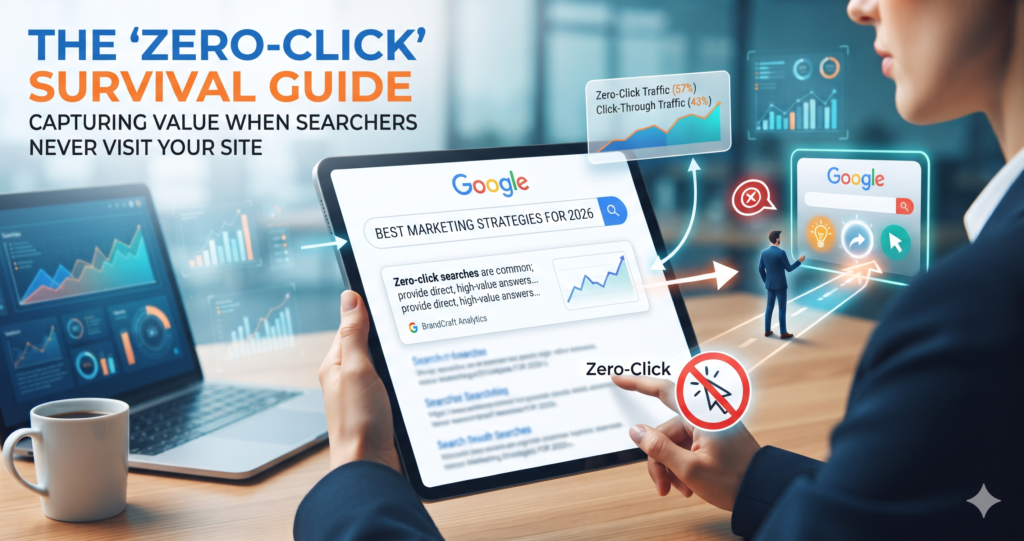
The “Zero-Click” Survival Guide: Capturing Value When Searchers Never Visit Your Site
The zero-click search ecosystem means search engines synthesize direct answers using AI Overviews, Featured Snippets, and Knowledge Panels, drastically reducing organic click-through rates (CTR). To capture business value in a post-CTR landscape, brands must shift from click attribution to brand influence attribution, engineer content for prominent citation cards and entity ownership, partition content between easily synthesized top-of-funnel answers and unsynthesizable proprietary tooling, and track dark funnel metrics like branded search volume, direct traffic lift, and post-conversion self-reported attribution (SRA).
The Zero-Click Reality: The Post-CTR SERP Landscape
For two decades, search engine optimization operated under an implicit contract: publish relevant, authoritative answers, and search engines reward you with user visits. Today, that contract has fundamentally changed. The modern Search Engine Results Page (SERP) is no longer a directory of blue links leading to external websites; it is a walled-garden answer engine designed to satisfy user intent directly on the results page.
Analyzing the Proliferation of AI Overviews, Featured Snippets, and Rich Cards
Modern search architecture prioritizes frictionless information retrieval. The widespread rollout of generative AI overviews, dynamic rich carousels, expandable “People Also Ask” cards, and high-density knowledge panels has systematically demoted organic links below the fold.
Where users once had to click three competing results to compare factual definitions, product specs, or regulatory guidelines, large language model (LLM) search layers now aggregate, distill, and present the synthesized answer at position zero. As a result, informational queries routinely yield a zero-click rate well exceeding 60%, leaving websites that rely solely on top-of-funnel informational traffic with declining session counts despite maintaining top rankings.
Why Falling Organic CTR Does Not Automatically Signal Declining Brand Demand
A common mistake among marketing teams is equating declining organic sessions directly with decaying brand health. When search engines answer queries natively:
- Brand Exposure Migrates to Source Chips: If your brand is prominently cited in AI source carousels, answer cards, and definition boxes, your brand equity still expands.
- Intent Condensation: Casual browsers looking for quick factual answers leave without visiting, filtering out low-intent bounce-rate sessions.
- Delayed Action: The users who do eventually visit often arrive via direct navigation or branded queries later in their buying cycle after repeatedly recognizing your brand as the canonical authority on the SERP.
Shifting from Traffic Attribution to Influence Attribution
When clicks vanish from your analytics dashboard, traditional last-click and first-click attribution models fail. To justify budget and prove organic search impact, marketers must transition to measuring on-SERP brand influence.
Traditional Funnel: Search Query ──► Organic Click ──► Site Pageview ──► Conversion
Zero-Click Funnel: Search Query ──► On-SERP Impression (AI Card) ──► Mental Anchor ──► Direct/Branded Lift ──► Conversion
Mapping On-SERP Brand Impressions to Direct & Branded Search Lift
While Google Search Console (GSC) tracks impressions, these impressions are typically divorced from actual conversions in standard analytics software. To measure their true impact:
- Correlate Impression Spikes with Branded Lift: Track the correlation coefficient between non-branded GSC impression surges (specifically queries where your domain appears in featured snippets or AI Overviews) and corresponding surges in branded query volume over a 30- to 90-day rolling window.
- Monitor Direct Traffic Entry Points: Track direct sessions landing on homepages and high-intent product pages shortly after major content wins on the SERP. High on-SERP visibility acts as digital out-of-home advertising—seeding brand recognition that converts through direct navigation.
Measuring the Multi-Touch Influence of Answer Box Dominance
Traditional multi-touch attribution (MTA) relies on cookies and tracking pixels—neither of which execute when a user views your brand inside an AI Overview without clicking.
To bridge this visibility gap:
- Establish baseline brand search lift in geographic regions where specific on-SERP snippets are captured versus control regions where competitor snippets appear.
- Quantify share of voice (SOV) across AI source recommendations using enterprise LLM-SERP tracking software, treating citation presence as an upper-funnel media impression.
Implementing Post-Conversion Self-Reported Attribution (SRA)
Because search engine native experiences belong to the “dark funnel,” quantitative tracking pixels will inevitably miss touchpoints. Post-conversion Self-Reported Attribution (SRA) closes this gap.
Add a simple, open-ended field to your sign-up or demo request forms:
“How did you first hear about us?”
Customers who consumed your content inside an AI Overview, rich card, or SERP summary will frequently write:
- “Saw your brand cited as the standard in Google’s AI overview”
- “Found your research cited in an answer box while researching compliance standards”
Categorize these qualitative entries under your organic influence umbrella to demonstrate direct pipeline contribution.
On-SERP Brand Real Estate Optimization
If searchers are not leaving the SERP, your job is to maximize the physical pixel footprint and visual dominance of your brand across the entire results page.
Structuring Answers for Prominent Source Card Placements
To ensure search engines cite your site as a top link card inside AI Overviews and Featured Snippets, adopt an inverted pyramid editorial structure:
- Direct Answer Capsule: Open every major subtopic with a 40–60 word, unambiguous answer written in direct subject-predicate syntax.
- Information Gain: Include distinct proprietary data points, named methodologies, or proprietary definitions immediately following the core summary. LLM parsers heavily weight unique semantic entities that are absent from generic web scraping.
- Semantic Schema: Implement clean, descriptive schema markup (Article, TechArticle, FAQPage, and HowTo) to allow machine extractors to parse structural hierarchies effortlessly.
Owning Knowledge Panels, Local Entity Cards, and Executive Profiles
Search engines categorize businesses not merely as websites, but as real-world entities inside an internal Knowledge Graph. Solidify your entity footprint by:
- Aligning structured data across Wikidata, Crunchbase, LinkedIn, and official corporate sites.
- Claiming and optimizing Google Business Profiles with complete, up-to-date service taxonomies and verified reviews.
- Cultivating executive Knowledge Panels for founders and subject-matter experts via detailed author schema, verified social accounts, and speaking citations across third-party industry journals.
Dominating Visual SERP Real Estate (Video Carousels & Image Packs)
Text-heavy results are increasingly displaced by multi-modal components. Dominate these visual modules by:
- Publishing short-form, high-intent video breakdowns on YouTube with explicit chapter markers and transcripts to capture Google Video Carousels.
- Replacing generic stock photography with original diagrams, process flowcharts, and branded infographics marked up with ImageObject schema to populate Image Packs and rich thumbnail previews.
Content Partitioning: What to Give Away vs. What to Gate
Not all content should be treated equally. Winning in a zero-click environment requires deliberate content partitioning based on synthesizability.
TOP-OF-FUNNEL: Give Away Freely
- Clear definitions, formulas, factoids
- High-density answer capsules
- Objective: Maximize AI citations & brand impression
BOTTOM-OF-FUNNEL: Protect & Gate
- Proprietary benchmarks & survey raw data
- Interactive tools & dynamic calculators
- Community, templates, and execution workflows
- Objective: Demand the click; resist AI synthesis
Top-of-Funnel Factoids: Designing for Direct SERP Extraction
Content that answers simple informational intents (“What is X?”, “Formula for Y”, “X vs Y comparison table”) cannot be protected from AI scraping. Attempting to withhold these answers behind clickwalls only guarantees that a competitor’s site will be cited instead.
Strategy: Give top-of-funnel answers away freely. Format them with concise, highly extractable definitions and explicit branding (e.g., “According to the [Brand] Framework…”). Make extraction seamless so your name becomes synonymous with the concept.
Bottom-of-Funnel Proprietary Assets: Creating Un-Synthesizable Value
Reserve your site visits for assets that an LLM cannot summarize or execute on a search engine page:
Interactive Calculators and Proprietary Tooling
Search summaries can explain mathematical principles, but they cannot dynamically run complex, multi-variable financial models, API-connected audit tools, or personalized ROI calculators. Build web-based micro-tools that require inputs and state manipulation to provide custom value.
Raw Datasets, Uncompressed Reports, and Community Access
While an AI summary can recite high-level statistical takeaways, it cannot provide:
- Downloadable CSV/XLSX raw benchmarking data.
- Customizable dashboards.
- Proprietary workflow templates (Notion, Figma, Excel).
- Access to private, peer-driven Slack or Discord communities.
Conversion Mechanics Within Search Surfaces
To capture clicks from users who see the summary, you must trigger a natural secondary intent that makes clicking the logical next step.
Triggering Secondary Intent: Giving Searchers a Reason to Click Through
Merely providing the answer creates a dead end. Every informational asset must plant open narrative loops and operational next steps:
- The “What” vs. The “How”: Let the SERP answer what a concept is, while your title and meta tags signal how to implement it with practical blueprints.
- Contextual Caveats: Emphasize that general rules have critical edge cases (“Why standard CAC benchmarks fail in 3 specific B2B sectors”), compelling readers who need deeper context to click through.
Optimizing Title Tags and Meta Hooks for the “Next Step” Beyond the Summary
Shift title tags away from generic informational labels toward execution-oriented hooks:
| Outdated Informational Title | High-Click Execution Title |
| What is SaaS Churn Rate? (Formula & Definition) | SaaS Churn Rate Benchmark + Downloadable Cohort Model |
| SOC 2 Compliance Checklist 2026 | SOC 2 Audit Prep: Automated Readiness Spreadsheet Included |
| How to Calculate Customer Lifetime Value | LTV Calculator: Interactive Multi-Variable Forecasting Tool |
The Modern Executive Dashboard: KPIs for a Zero-Click Organic Strategy
Traditional dashboards track rank, organic clicks, and session bounce rates. The zero-click organic framework requires an updated scorecard:
| KPI Category | Metric | Source | Strategic Objective |
| Visibility & Footprint | Non-Branded SERP Impressions | Google Search Console | Measure total top-of-funnel brand visibility across generative and rich elements. |
| AI Dominance | AI Overview / Citation Frequency | Specialized LLM Rank Trackers | Quantify domain inclusion rate across generative answers. |
| Brand Demand | Branded Search Query Volume | GSC & Keyword Tools | Track long-term brand discovery and brand authority generation. |
| Direct Navigation | Direct Sessions to Key Landing Pages | Web Analytics (GA4) | Measure users returning via bookmarks, URL auto-complete, and memory. |
| Dark Funnel Pipeline | Self-Reported Attribution Volume | Form Fields / CRM | Measure qualitative conversion touchpoints credited to search discovery. |
Frequently Asked Questions (FAQs)
How do you report organic marketing ROI to stakeholders if traffic drops?
Show the correlation between organic search visibility (total impressions and AI citation share) and high-intent commercial metrics, such as branded search lift, direct traffic growth, and sales pipeline. Frame total sessions as a vanity metric: an agency or marketing team’s ultimate objective is qualified pipeline, and shedding empty, zero-intent traffic while growing branded demand actually improves lead quality and conversion efficiency.
What is Self-Reported Attribution (SRA) and how is it implemented?
Self-Reported Attribution is a qualitative attribution method where you include a single, ungated, free-text input field on your demo or checkout form asking, “How did you hear about us?” It requires no complex tracking architecture; you simply tag and group responses inside your CRM into categories such as “SERP AI Overview,” “Google Snippet,” or “Podcast.”
Can optimizing for zero-click queries hurt commercial conversion rates?
No, when structured intentionally. Optimizing for zero-click queries places your brand at the critical initial point of user awareness. By satisfying basic informational intent directly while signposting your proprietary tools, data, and consultative offerings, you weed out unconvertible informational traffic while positioning your brand as the leading authority when searchers transition into commercial purchasing stages.
What types of content are safe from AI synthesis extraction?
Content that resists AI synthesis includes:
- Interactive Utilities: State-dependent tools, calculators, sandbox generators, and diagnostic questionnaires.
- First-Party Empirical Research: Original proprietary benchmarks, primary survey findings, and downloadable raw datasets.
- Subjective Narrative & Opinion: Counter-intuitive thought leadership, deep post-mortems, and expert roundtables.
- Ecosystem Assets: Downloadable design files, spreadsheet templates, and gated professional communities.